





Advertorial


Share
Published 09:57 18 Oct 2024 BST
 Add us as a preferred source on Google »
Paid partnership with Visa.
Ireland is home to many incredible women-owned businesses, and the Visa's She’s Next Grant Programme is helping to spotlight these inspiring entrepreneurs.
This programme offers a chance for these businesswomen to elevate their ventures with amazing prizes. This year, Visa will select five winners in total with grants of up to €50,000 available. Plus, the programme includes fantastic training, networking opportunities, and one-on-one mentoring.
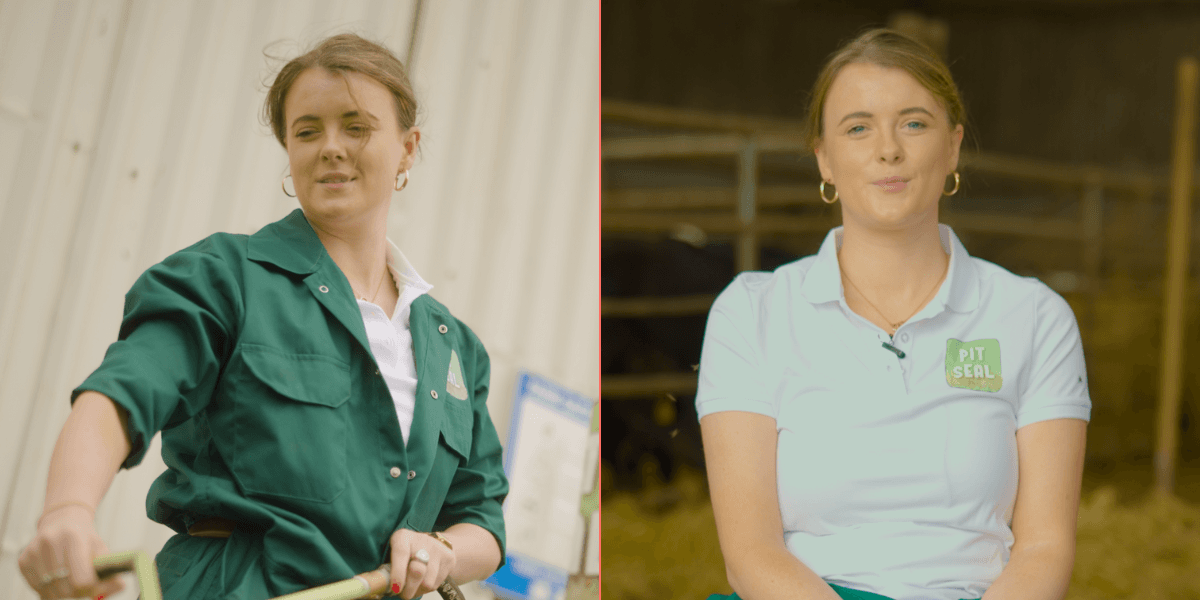
You can apply to the programme right here. We caught up with previous winner, Marion Cantillon, who founded Pitseal, who shared how the Visa's She's Next Grant Programme helped grow her business.
Pitseal is the name of the business and what we do is we replace plastic on silage pits. This is where farmers store grass over the winter months to feed their animals. It's currently being covered with the likes of big plastic sheets and waste tyres, so that's both environmentally damaging and a massive safety risk for any farmer because these pits are quite large.
During the winter, when it's wet and windy, the farmer will have to mount the pit if the plastic lifts in any way; mounting a pit that's 6 or 7ft high is a cumbersome task, never mind when it's wet, windy or stormy outside. There are a lot of issues around mounting and covering pits so we just completely wanted to rethink the game.
Oh, it was amazing. There were five of us, so we made a little group chat, and it's been a support network since then. Obviously our businesses are very different but it's been great just to touch base with the girls because a lot of us would be going through maybe similar issues. It's good to hear different sounding boards.
We also got a lot of support from the coaching available. They were really cool around financial projections and trying to manage the business, and useful bookkeeping skills. It's nice to bring it back to the basics because sometimes you have a start up and you end up juggling a lot of balls in the air; it's nice to remember how to manage the basics and make sure everything runs smoothly.
Of course the prize was amazing, it was amazing to have that injection of money into the business. We put it straight into our applicator, into the product, and it allowed us to cover three additional farms this season, which was brillant and a game-changer for us in serving our customers and getting the product out there.
My customer is the contractor. On farms they hire out to contractors to cover the pits, which is where I come in, but the real benefit is seen by the farmers themselves.
We have a community built now, which has been fantastic through our testing phase, and right up until this day, there's two way communication between the farmer, the contractor and myself. It's been great to see the whole process go through, so it'll be the contractor to cover the pit but it'll be the farmer opening up the pit and feeding his animals, so it's nice to hear from the farmer's side and the contractor's side.
We're doing some tests in New Zealand and Australia, so they're my next biggest hits, the next biggest milestone. I'm happy in Ireland and Europe, but it's seasonal, so I have a counter season. We do have some very exciting speeches and talks coming up; I'm going to Dubai in November to check out the market over there and I'm going to Silicon Valley, which is a big agriculture community with a lot of big contractors and big multinationals in the space.
I definitely want to try to go on a more global level, with obviously New Zealand, Australia and the States being the biggest markets.
That's really tough, there's so many. I think it was one of the first piece of advice I got; I came from an academic side into business, I didn't think I'd have a start up. I didn't think I'd be a founder.
One of the biggest pieces of advice I got was to love the problem. I know it sounds so basic but I think there are days where having a business, it really does hit you that you'll go through some lows and some fantastic highs, but you really love what you're trying to solve. The advice is to have the passion for the actual problem. It's to see it as a bigger thing, it's not just a product, you're actually solving a problem for somebody.
I think that's the same with any line of work that you do.
Maybe just take it with a grain of salt, because a lot of the stuff is fantastic as generic advice, and you can nearly read it off a book. But your case can be so specific that if a market or an industry is really calling your name and you wouldn't actually make the correlation, let's say on textbook if you read about the business. I think go with your gut and go with your own instincts.
Just take every piece of advice that you're given with a pinch of salt and apply it in your own life scenario and your own situation, because I don't think everyone fits perfectly into a lovely little mould; I think that model is gone. I don't think there is one route for every business or one strategy. You mould into different ways and you evolve with your business as it grows.
Be able to take nuggets of advice where it resonates, but leave what isn't suitable for you and don't feel guilty about it.
You can find more information as well as the application details for Visa's She's Next Grant Programme here. The closing date for entries is 30th October 2024.
1 x €50,000 and 4 X €10,000 grants available. Open to women-owned businesses in ROI. T&C apply*.
My uncle ended up falling and slipping off the pit many years ago. I had to take up the reins and help out on the family farm a bit during that period and I remember doing it, and thinking 'This is so cumbersome, so tedious and so unnecessary. There's surely an easier way.' And I guess it was kind of spur of the moment because I was doing a masters in nutritional science, and we were tasked with replacing plastic in big retail spaces and supermarkets. Our thesis was to replace plastic on fresh fruit and veg but I was doing this as I was helping out the farm so it was kind of a light bulb moment being like, 'Oh, if I can write about this being replaced in small quantities at supermarket level, why can't we just try and scale this up and see?' Naturally my supervisors lost their minds when I came to them and told them I wanted to change my thesis.
That's the drive that actually has to run the business, because there'll be days that you don't want to get out of bed at 4 or 5 in the morning to go down to the farm. There'll be days that you don't want to be doing books at 9 or 10 at night. So it's just to have that drive and passion, but have it for a problem that you're solving that you're really passionate about. That will let you push through the ungodly hours of the morning or evening you're working.
This is probably contradictory to what I just said, but I'd advise not to take every piece of advice so literally. I think in a start-up space, which is so fantastic, you're given so much help and support from everyone around you, and there's competitions, accelerators, boot camps, you name it. There's people offering advice and guidelines and what you should be doing, what you shouldn't be doing, where you should be going, what you should be pursuing and what you shouldn't be pursuing.


Advertorial

Advertorial

Advertorial

Advertorial
Northern Threads brings summer styles to Titanic Belfast
Brought to you by Titanic Belfast Belfast has long been recognised for its creativity, craftsmanship and warm hospitality, making it one of the UK and Ireland’s most exciting city break destinations. At the heart of the city’s cultural and tourism offering is Titanic Belfast, an award-winning visitor attraction that continues to welcome guests from around […]
Advertorial
1 week ago
A job in An Garda Siochána is filled with variety
Brought to you by An Garda Siochána Explore the opportunities available to women in An Garda Siochána. In July of 1959 the first twelve women joined the ranks of An Garda Síochána; today women account for approximately 37% of all personnel across the organisation. An Garda Siochána offers women equal opportunities to explore a rewarding […]
Advertorial
3 weeks ago
Advertorial