






News


Share
Published 13:31 23 Sept 2024 BST
Updated 16:21 23 Sept 2024 BST
 Add us as a preferred source on Google »
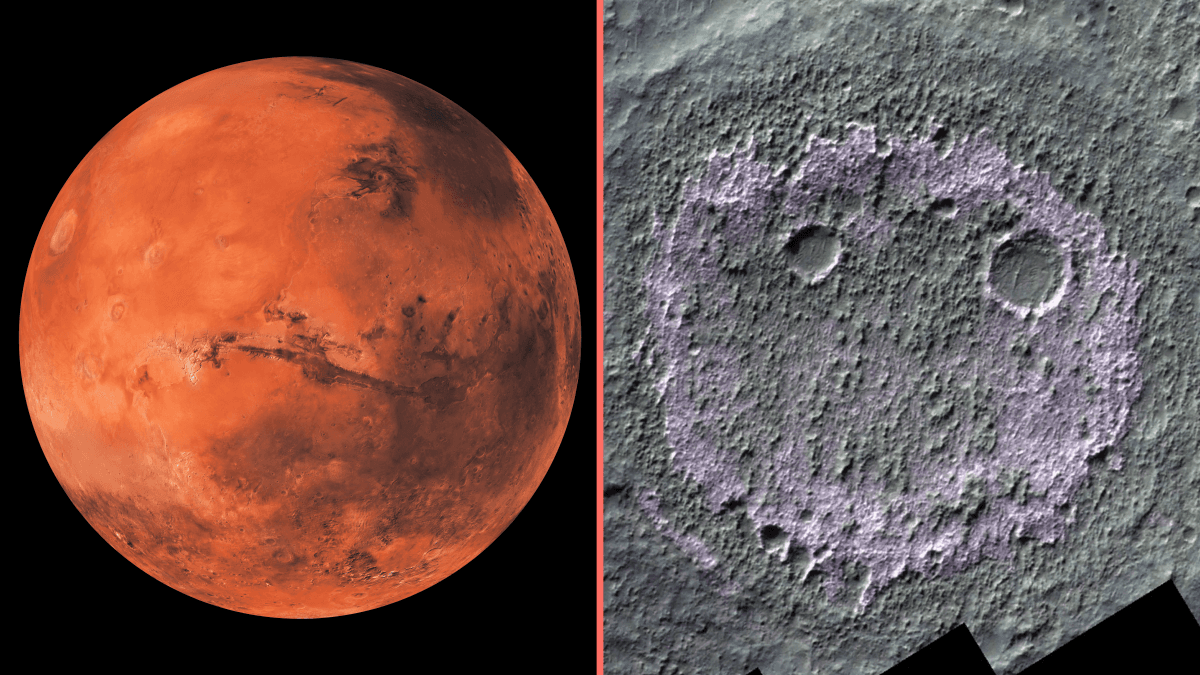
Scientists have discovered a 'smiley face' on Mars which they think could hide ancient indicators of life on the lonely red planet.
The news comes as recent images were shared by the European Space Agency (ESA) last week, picturing what looks like a 'smiley face' drawn onto the surface of the planet.
Unsurprisingly, this drawing isn't the work of little green men trying to send emojis through the cosmos, but the work of nature over time.
The face, made up of two dots and a line inside a large circle, is said to be the remnants of an ancient lake that dried up billions of years ago, and can only be seen under infrared light.
The hidden face was captured by ESA's ExoMars Trace Gas Orbiter, which, since 2016, has been recording levels of gases such as methane in the Martian atmosphere.
With the image came the caption on the ESA's Instagram account: "Once a world of rivers, lakes, and possibly oceans, Mars now reveals its secrets through chloride salt deposits found by our ExoMars Trace Gas Orbiter.
"These deposits, remnants of ancient water bodies, could indicate habitable zones from billions of years ago.
"The discovery of nearly a thousand potential sites offers new insights into Mars’ climate and potential for past life."
Scientists have long pondered what Mars could have once reassembled, potentially being a wet world of rivers, lakes and oceans.
The ESA's discussed this during a paper published in the journal Scientific Data last month.
"In the distant past, water formed magnificent landforms such as riverbeds, channels, and deltas on the Red Planet," said study lead author Valentin Bickel in a statement for the ESA.
The lines and dots on the surface originate from the salt left behind from these bodies of water, forming a shape human's perceive as a smile.
The study says such deposits are important as they "provide optimal conditions for biological activity and preservation," making the area a "prime target for astrobiological exploration."
Meanwhile the salt deposits can provide some of the only evidence we have so far for the existence of water on Mars, as the high salt content in the water would have prevented it from freezing, potentially be the last place for any life to survive before the planet turned to desert.
If this was the case, the salt may have preserved the now long-dead lifeforms, making the area of high interest for exploration in the future.
"The new data has important implications for our understanding of the distribution of water on early Mars, as well as its past climate and habitability," Bickel said.
This new discovery could prove fertile for expanding our understanding of life in our universe and whether we truly are alone in this universe.


News

News

News

News
The thrilling new Irish novel you won’t be able to put down
Gill Perdue is back with one of her best books yet If you’re looking for a gripping Irish novel to delve into this week, then look no further than All of Them Lied by Gill Perdue. lkt Gill Perdue is one of the finest Irish crime writers, and we couldn’t be happier to see her […]
News
6 days ago
Signs Charleen Murphy could be heading into the Love Island villa labi e
We’re convinced! Many Fans were left disappointed when Irish influencer Charleen Murphy was missing from the original Love Island line-up ahead of this season. And after the first few “bombshell” arrivals of the season, fans are beginning to lose hope that their favourite content creator will be making an appearance on this year’s show. However, die-hard […]
News
6 days ago

News
Man accused of Parnell Square stabbing pleads not guilty
News