



Share
Published 16:25 17 Jul 2014 BST
Updated 13:08 11 Jun 2015 BST
 Dawn begins quite a number of years after the end of Rise. Simian flu has virtually wiped out the population of humans and the apes, led by Caesar keep to themselves and live a highly sheltered life within their own community. Humans have not been seen in a long time and Caesar continues to keep the peace believing that the entire population has died out. However, after a hunting expedition with the rest of the clan, one of the apes is shot by a man who is in search of a dam which holds the only power source for the humans. Caesar quite loudly insists that the company leave but Malcolm, their leader insists they press on to the energy source, hoping that he can come to an agreement with Caesar.
Thankfully, due to his upbringing, Caesar feels a certain amount of pity for the humans and allows them access to the dam but, of course, there is always one renegade and with one of those on both sides, it seems the way forward is completely impassable. Caesar is faced with a tough decision, put the Ape population first and cut ties with the humans forever or trust those who once took care of him and brought him up like their own.
For the most part, Dawn is haunting with far too many echoes of human society today as we know it and the difficulties it faces. The Apes face mostly the same dilemmas the humans do and interestingly, for every human in Dawn, there is an ape who is his/her counterpart. They really are not so different from us, as Caesar likes to point out. The breakdown of society and the power hungry nature of some of the characters is far too reminiscent of a lot of our issues in society, problems that are emphasised throughout the film.
It's also shot beautifully. The scenes in the forest are absolutely stunning, you can tell this is where they really did not want to use the CGI effects. Although the effects are more than evident throughout the film, they do blend in seamlessly, making this quite a beautiful film to watch. The scene where the apes take over while one sits on the American flag is flawless. Absolutely flawless. Thanfully, losing Rupert Wyatt as director for the second film doesn't seem to have affected the project. In fact, he could be proud of Reeves' work.
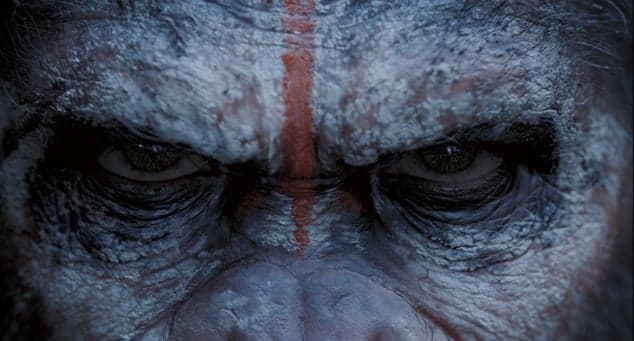
Serkis steals the show. With performance capture as a tool, it could be quite easy to get lost within the technology but you just need to take one look at his eyes to know he is ever present and full of soul. Koba, played by Toby Kebbell, is positively petrifying. In fact, though there is quite the argument that the human characters are brilliant here like Jason Clarke's Malcolm and Gary Oldman's Dreyfus, the filmmakers would be well within their rights to abandon the human aspect entirely for the next film, if there is one.
With the way these films are going, we really hope there will be.
Dawn begins quite a number of years after the end of Rise. Simian flu has virtually wiped out the population of humans and the apes, led by Caesar keep to themselves and live a highly sheltered life within their own community. Humans have not been seen in a long time and Caesar continues to keep the peace believing that the entire population has died out. However, after a hunting expedition with the rest of the clan, one of the apes is shot by a man who is in search of a dam which holds the only power source for the humans. Caesar quite loudly insists that the company leave but Malcolm, their leader insists they press on to the energy source, hoping that he can come to an agreement with Caesar.
Thankfully, due to his upbringing, Caesar feels a certain amount of pity for the humans and allows them access to the dam but, of course, there is always one renegade and with one of those on both sides, it seems the way forward is completely impassable. Caesar is faced with a tough decision, put the Ape population first and cut ties with the humans forever or trust those who once took care of him and brought him up like their own.
For the most part, Dawn is haunting with far too many echoes of human society today as we know it and the difficulties it faces. The Apes face mostly the same dilemmas the humans do and interestingly, for every human in Dawn, there is an ape who is his/her counterpart. They really are not so different from us, as Caesar likes to point out. The breakdown of society and the power hungry nature of some of the characters is far too reminiscent of a lot of our issues in society, problems that are emphasised throughout the film.
It's also shot beautifully. The scenes in the forest are absolutely stunning, you can tell this is where they really did not want to use the CGI effects. Although the effects are more than evident throughout the film, they do blend in seamlessly, making this quite a beautiful film to watch. The scene where the apes take over while one sits on the American flag is flawless. Absolutely flawless. Thanfully, losing Rupert Wyatt as director for the second film doesn't seem to have affected the project. In fact, he could be proud of Reeves' work.
Serkis steals the show. With performance capture as a tool, it could be quite easy to get lost within the technology but you just need to take one look at his eyes to know he is ever present and full of soul. Koba, played by Toby Kebbell, is positively petrifying. In fact, though there is quite the argument that the human characters are brilliant here like Jason Clarke's Malcolm and Gary Oldman's Dreyfus, the filmmakers would be well within their rights to abandon the human aspect entirely for the next film, if there is one.
With the way these films are going, we really hope there will be.
Entertainment

Entertainment

Entertainment

Entertainment

Entertainment