









News


Share
Published 12:01 29 Oct 2025 GMT
Updated 15:34 29 Oct 2025 GMT
 Add us as a preferred source on Google »
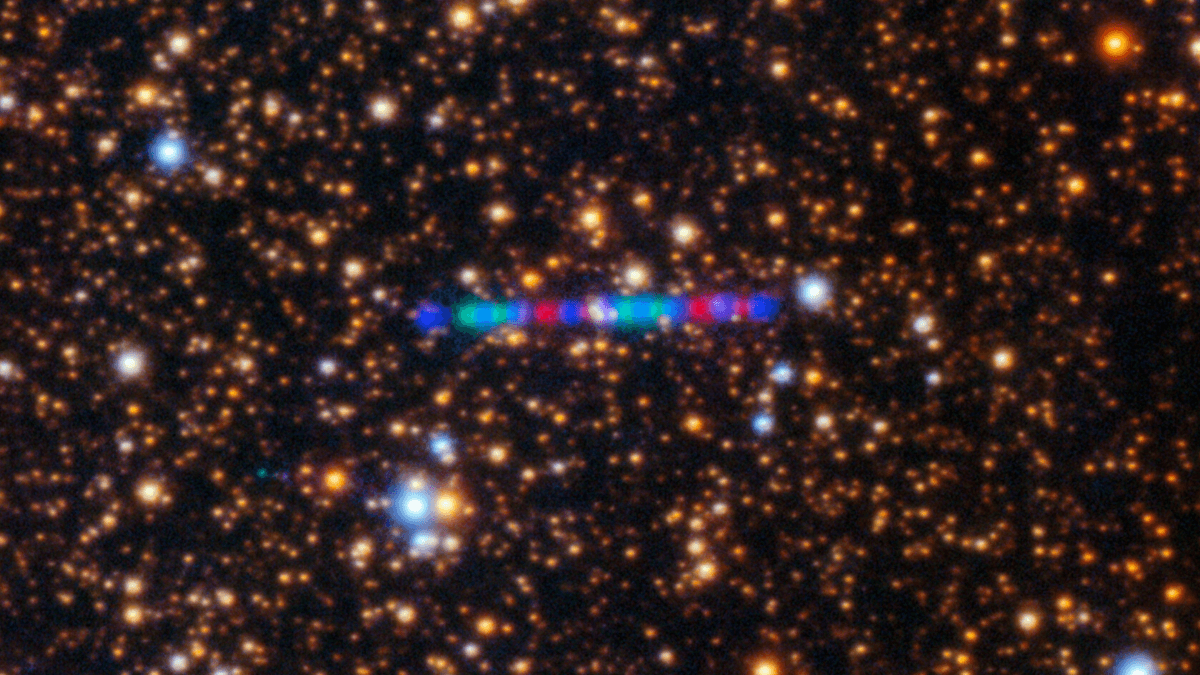
A Harvard scientist who claimed that an object hurtling through space may not be a comet but in fact an alien probe has warned people to 'brace themselves' as it may arrive today (29 October).
Writing in the controversial study, they said: “The consequences, should the hypothesis turn out to be correct, could potentially be dire for humanity.”
The research was conducted by Avi Loeb, Adam Hibberd and Adam Crowl, with Loeb writing in a blog post that he believes that the position of this object offers “various benefits to an extraterrestrial intelligence.”
Loeb claims that there is 30 to 40 per cent chance that the object is not a 'naturally formed' object.
By late November the entity will slip behind the sun and not be visible to Earth.
Loeb adds: “This could be intentional to avoid detailed observations from Earth-based telescopes when the object is brightest or when gadgets are sent to Earth from that hidden vantage point.”
Loeb believes that this could lead to an attack which could “possibly require defensive measures to be undertaken.”
In a previous interview with CNN, Loeb claims that one detail points to 3I/ATLAS being different from a regular comet.
“Usually, for comets, you see a tail trailing behind the object,” he said.
“Here, the glow is actually in front of it. We’ve never seen such a thing. A comet doesn’t glow in front.”
In a blog post, he described the glow as “puzzling”.
“It may come to save us or destroy us. We’d better be ready for both options and check whether all interstellar objects are rocks.”
He explained that the “existence of a glow ahead of 31/ATLAS but no evidence of gas molecules” is confusing.
Loeb does not think that we are definitely about to be invaded by aliens, but that it is a possibility.
He even thinks that they might provide a learning experience for us.
"They are much more sophisticated they wouldn't care much about us and it's actually an opportunity for us to learn about the future technologies that they posses," he added.
"It would take us a long time to develop ourselves so for us it will be a learning experience."
He previously told The Big Bang Theory actor Mayim Bialik that 29 October was the day to watch out for.
"If you want to take a vacation, take it before [October 29], because who knows what will happen?"
This is because today marks the object's perihelion, which means it is the day it comes closest to the sun, and Loeb thinks this could be the day the potential aliens look to make contact.
He explained that the perihelion could be significant due to the Oberth effect, as it is "most energy-efficient for a spacecraft engine to burn its fuel when its orbital velocity is greatest."
"If 3I/ATLAS is a massive mothership, it will likely continue along its original gravitational path and ultimately exit the Solar System. In that case, the Oberth manoeuvre might apply to the mini-probes it releases at perihelion towards Solar system planets."
However, not everyone is convinced by Loeb’s theory of potential aliens.
Samantha Lawler, an astronomer at the University of Regina in Canada who studies solar system dynamics, said: “All evidence points to this being an ordinary comet that was ejected from another solar system, just as countless billions of comets have been ejected from our own solar system.”
Even Loeb himself admitted his spy theory is somewhat far-fetched.
He said: “By far, the most likely outcome will be that 3I/ATLAS is a completely natural interstellar object, probably a comet.”
He even warned the public to take his paper with a pinch of salt.
Loeb added: “This paper is contingent on a remarkable but, as we shall show, testable hypothesis, to which the authors do not necessarily ascribe, yet is certainly worthy of an analysis and a report.
“The hypothesis is an interesting exercise in its own right, and is fun to pursue, irrespective of its likely validity.”
Explore more on these topics:

News

News

News

News
Dáil passes abortion bill to remove mandatory three-day waiting period
Government officials voted on the abortion bill last night. Irish politicians have voted in favour of removing the three-day waiting period for an abortion. The vote was completed in the Dáil last night, and the Sinn Féin bill was passed by 86 votes to 70. In Ireland, there is currently a three-day waiting period between […]
News
4 days ago
Love Island fans can’t get enough of Fitzy’s iconic Irish phrase
It’s definitely a fan favourite! Viewers cannot get enough of Fitzy’s Irish lingo on the show, and his most recent comment has left fans wanting more. The GAA star, who is currently coupled up with police detective, Lola Deal, offered his mate Tommy Murphy some thoughtful advice after his actions left his partner Ellie ‘fuming’. […]
News
6 days ago

News
Online shopping is about to become more expensive in Ireland – here’s what you need to know
News